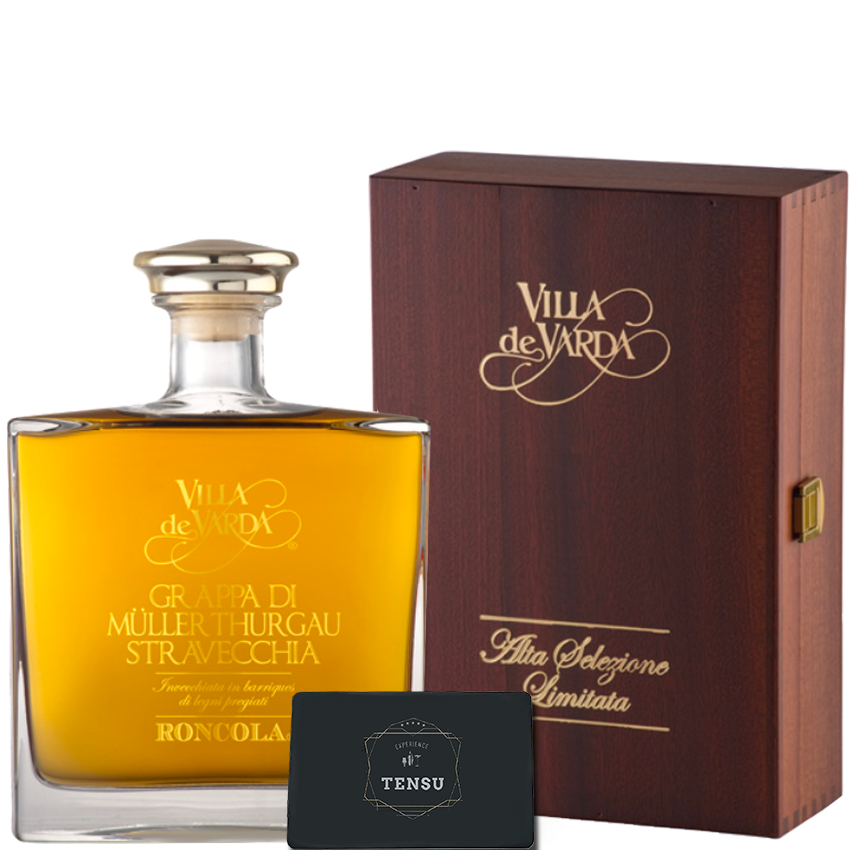
Villa de Varda Grappa di Muller Thurgau Stravecchia Roncola 40.0 "OB"
€99,95
Price incl. 21% btw (21%) €17,35
1 available
1
Product Details
Brand: Villa de Varda
Country: Italy
Region: Trentino
Bottler: OB
Selection: Distillery
Type: Monovitigno
Grape variety: Müller Thurgau
Edition: Stravecchia Roncola
Maturation: Acacia & Cherry Wood Barrels for many years
Abv. %: 40.0
Detail: Wooden giftbox
Content/cl: 70
Weight/kg: 2
Weight: 2 kg
Villa de Varda Grappa di Müller Thurgau Stravecchia Roncola [Official Bottling] Aged grappa riserva from the Alta Selezione collection - 40.0% abv.
When the selected Müller Thurgau grape skins meet the de Varda method and are aged for a long time in our wood barriques an exclusive Alta Selezione grappa is born: Aged grappa riserva Müller Thurgau Stravecchia Roncola. The wooden coffret and the fact sheet hand signed by the master distiller enhance this precious bottle.
Color: amber with yellow gold strikes
Nose: refined, intense, pleasantly fruity of apricot, cherry, blackcurrant, red ripe fruit, toasted notes of hazelnut, vanilla, cocoa, coffee, amaretto biscuit and floral
Taste: exceptionally smooth and refined, elegant, well rounded, of great aromatic richness, fully confirming the fruity, floral and toasted hints felt on the nose.
Grappa is an Italian distilled alcoholic beverage, originally made by distilling the leftovers of grapes after winemaking — that is, the skins and seeds. Originally, it was a way to avoid wasting surplus grape bunches at the end of the season. Today, however, there are many distilleries that produce only grappa, with quality as their primary focus.
The taste of grappa, like that of wine, depends on the type of grape, its quality, the barrels in which it is aged, and the production process (continuous or discontinuous). Grappa has a minimum alcohol content of 37.5%. The law specifies only a minimum alcohol level, not a maximum. In practice, the alcohol content ranges between 40% and 60%.
Grappa is a protected product name in the European Union. To use the name “grappa,” the following conditions must be met:
- Produced in Italy or in the Italian-speaking part of Switzerland.
- Made from grape pomace.
- Fermentation and distillation must take place on the pomace.
The second condition does not allow the use of grape juice for fermentation. The third condition has several important consequences. Because distillation must take place on a relatively “dry” substance — the pomace — it is usually carried out in a bain-marie or with steam to prevent the pomace from burning. This requires very careful handling of the distillation process. The woody parts of the pomace (the stems and grape seeds) ferment together with the sugar-rich liquid still present in the skins, producing a small amount of methanol. Methanol is toxic and must, of course, be removed from the distillate. To control the public health risks associated with this and to curb illegal grappa production, the Italian government once enacted a law requiring winegrowers to sell their grape pomace only to licensed grappa distillers.
Natalie Berkowitz, The Winemaker’s Hand: Conversations on Talent, Technique, and Terroir
Save this product for later
You May Also Like
Display prices in:EUR